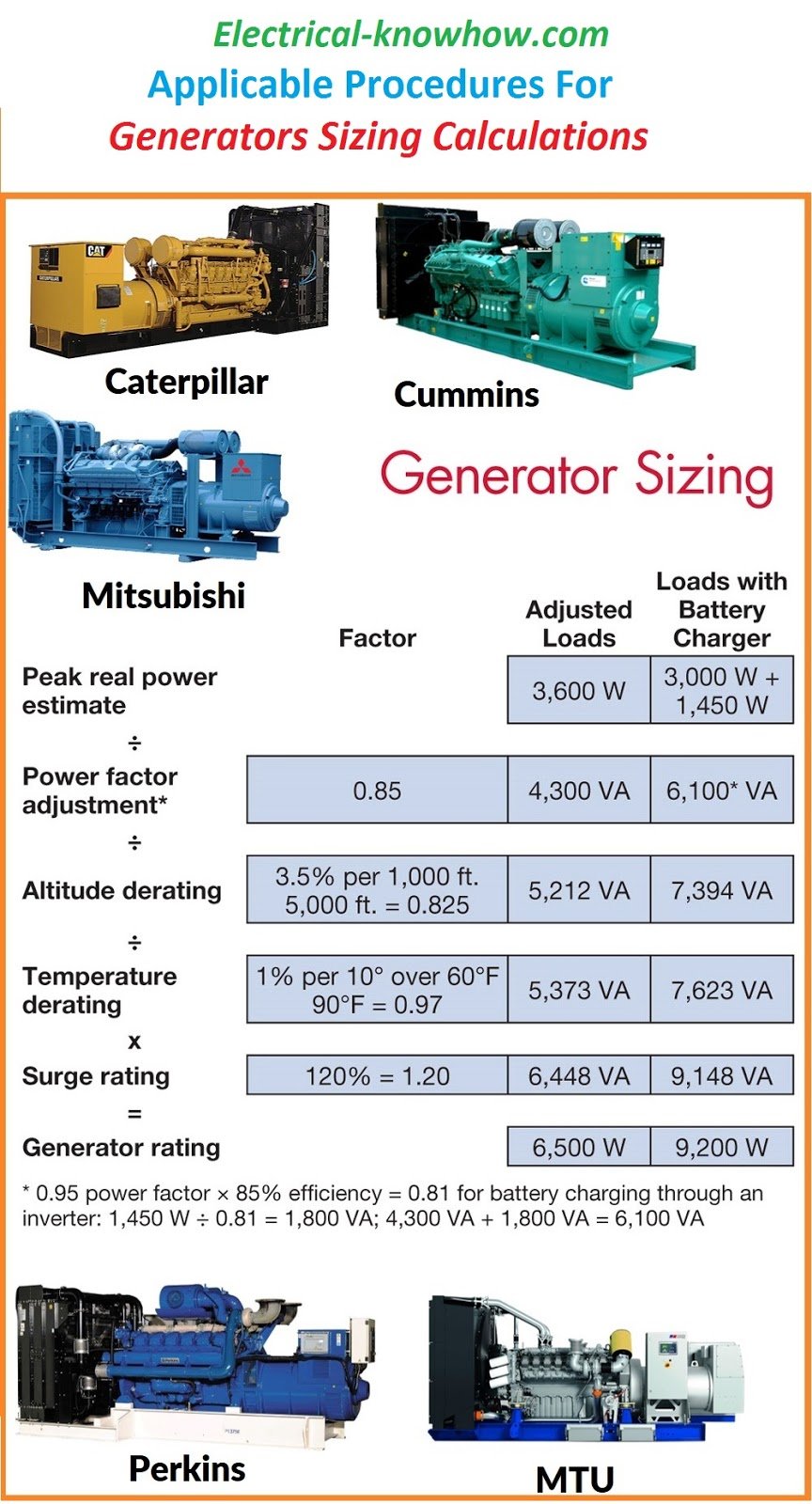
A sudden blackout plunges your home or business into darkness, but you’re prepared. Your generator kicks in, humming to life... only to trip a breaker moments later, or worse, struggle to power even your most essential equipment. This isn't just an inconvenience; it's a stark reminder that when it comes to backup power, simply having a generator isn't enough. The true reliability of your system hinges on a precise calculation, a nuanced process that begins with a solid Understanding Electrical Terms for Generator Sizing.
Getting generator sizing right isn't about guessing; it's about speaking the language of electricity. It means knowing the difference between a whisper and a roar in electrical demand, anticipating the sudden surge of a motor starting, and understanding how environmental factors can quietly chip away at your generator's potential. Miscalculate, and you risk everything from fuel waste and premature equipment wear to frustrating power outages and even costly damage. But nail it, and you unlock stable, efficient, and truly dependable power when you need it most.
At a Glance: Key Takeaways for Smart Generator Sizing
- Running vs. Starting Power: Appliances need a burst of power (starting watts/kVA) to kick on, far more than they need to run continuously (running watts/kW). Always account for this surge.
- Connected vs. Demand Load: Don't just add up every device's rating (connected load). Focus on what will actually run simultaneously (demand load) to avoid oversizing.
- Power Factor Matters: Generators are rated in kVA, but your appliances use kW. The relationship between them (Power Factor) is critical; a lower Power Factor means you need a larger kVA generator.
- Motor Inrush is King: Electric motors (HVAC, pumps, refrigerators) demand huge power surges at startup. Sizing must prioritize handling the largest motor's starting requirements.
- Environment & Future: Altitude, temperature, and even future expansion plans can reduce your generator's effective capacity. Don't forget to factor in derating and potential growth.
- Expertise is Priceless: Generator sizing is complex. Professional assessment ensures safety, compliance, and long-term reliability.
Why Precision Powers Performance: The Cost of Getting Sizing Wrong
Imagine buying a pair of shoes that are two sizes too big, or trying to squeeze into a pair two sizes too small. Neither works well, right? The same principle applies to generators. Incorrect sizing is one of the most common, and most costly, mistakes homeowners and businesses make.
An undersized generator will constantly struggle. It might trip circuit breakers frequently, refuse to start crucial motors (like your AC unit or well pump), and deliver unstable voltage and frequency, which can damage sensitive electronics. In a crisis, an undersized unit is practically useless.
On the flip side, an oversized generator isn't just wasteful; it can be detrimental. Running a generator consistently below its optimal load can lead to "wet stacking"—a condition where unburnt fuel and carbon build up in the exhaust system, causing reduced efficiency, higher fuel consumption, increased maintenance, and even premature engine failure. It's like driving a truck to pick up a single envelope; inefficient, expensive, and not great for the engine in the long run.
The sweet spot? A properly sized generator. This ensures stable voltage and frequency for all your equipment, maximizes fuel efficiency, extends the life of your engine, and keeps you compliant with crucial safety and electrical regulations.
The ABCs of Generator Power: Essential Electrical Terms Explained
Before we dive into the sizing process, let's get comfortable with the vocabulary. These aren't just technical jargon; they're the building blocks for making informed decisions.
Running Watts vs. Starting Watts (kW vs. kVA)
This is perhaps the most critical distinction in generator sizing.
- Running Watts (kW - Kilowatts): This is the continuous power an appliance needs to operate once it's already running. Think of your refrigerator humming along, a lightbulb glowing, or your computer operating. This is the "steady state" demand.
- Starting Watts (kVA - KiloVolt-Amperes): This is the momentary surge of power an appliance, especially one with an electric motor, requires to start up. Imagine the sudden jolt of electricity needed to kick-start your air conditioner compressor or washing machine motor. This "inrush current" can be 2-7 times (or even more) higher than the running watts.
Why the difference matters: Your generator must be capable of handling the starting watts of your largest single motor load, plus the running watts of all other simultaneously operating equipment. A common mistake is to only calculate running watts, leading to an undersized generator that stalls or trips when a motor tries to start.
While watts (kW) represent "real power" (the power actively doing work), generators are often rated in kVA (kilovolt-amperes), which represents "apparent power" – the total power the generator can supply. We'll explore the relationship between kW and kVA with Power Factor next.
Connected Load vs. Demand Load: The Reality Check
Don't let these terms trip you up; they're about being practical.
- Connected Load: This is the theoretical maximum power demand if every single electrical device connected to your system were running at its full rated capacity simultaneously. It's the sum of all nameplate ratings.
- Demand Load: This is the realistic power you actually need. It's the maximum power that will be used by equipment running simultaneously at any given time.
Consider your home: You have dozens of lights, multiple TVs, kitchen appliances, and more. If you added up the wattage of every single one, that would be your connected load. But how often do you have every light on, every TV playing, the dishwasher running, the microwave heating, and the vacuum cleaner going all at once? Rarely, if ever. The demand load accounts for this reality, applying "diversity factors" or "demand factors" based on typical usage patterns for various applications (residential, commercial, industrial). Focusing on demand load prevents unnecessary and costly oversizing.
Power Factor (PF): Not Just a Math Problem
Power Factor is a number between 0 and 1 that describes how efficiently electrical power is being used. It's the ratio of real power (kW) to apparent power (kVA).
- PF = kW / kVA
Why it's important:
Generators are rated in kVA (their total apparent power capacity), but most loads (appliances) are rated in kW (the real power they consume). A standard Power Factor of 0.8 is often assumed for generators by bodies like IEC unless otherwise specified. - If your generator is rated at 100 kVA with a 0.8 PF, it can effectively deliver 80 kW of real power (100 kVA * 0.8 = 80 kW).
- Loads with motors, like air conditioners or pumps, often have a "lagging" (lower) power factor. If your load has a Power Factor of 0.7, that 100 kVA generator can only supply 70 kW of real power (100 kVA * 0.7 = 70 kW). This means lower PF loads require a higher kVA capacity generator to deliver the same amount of usable kW.
Understanding Power Factor ensures your generator's kVA rating translates into enough usable kW for your actual power needs, preventing an undersized system despite a seemingly adequate kVA rating. To dive deeper into Power Factor, check out our detailed guide.
Voltage, Amperage, and How They Play Together
While kW, kVA, and PF are central to sizing, voltage and amperage are the foundational elements of your electrical system.
- Voltage (V): The "pressure" or "force" of electricity that pushes current through a circuit. Common voltages in homes are 120V and 240V. Commercial and industrial settings often use higher voltages like 208V, 277V, or 480V.
- Amperage (A): The "flow" or "quantity" of electrical current. Appliances are rated for specific amperage draws at a given voltage.
These three are intertwined by a fundamental relationship (simplified for AC power with Power Factor): - kW = (V * A * PF) / 1000 (for single-phase)
- kW = (V * A * PF * √3) / 1000 (for three-phase)
You'll often convert amps to watts (or vice versa) to ensure your generator and electrical panel can handle the load. Knowing your system's voltage requirements (e.g., a 120V refrigerator vs. a 240V oven) is crucial for proper connection and sizing.
Your Step-by-Step Blueprint for Accurate Generator Sizing
With the electrical terms clarified, let's walk through the methodical process of sizing your generator. This isn't a shortcut; it's a careful calculation that ensures reliability.
1. Cataloging Your Electrical Consumers: The Load Inventory
Your first mission: create a comprehensive list of every single electrical load you intend to power with your generator. Be meticulous.
For each item, gather the following:
- Appliance Name: (e.g., Refrigerator, Sump Pump, HVAC, Laptop, Lights)
- Rated Power (Watts or Amps): Look at the nameplate on the appliance. If only amps are listed, note the voltage.
- Operating Voltage: (e.g., 120V, 240V, 208V)
- Starting Method: Is it a simple resistive load (like a light bulb)? Or a motor that needs a big jolt (like a well pump or central AC)?
- Essential vs. Non-Essential: Prioritize. In a home, lights, fridge, and Wi-Fi are typically essential. A hot tub, less so.
Pro Tip: For home generator sizing, focus on truly essential items first. What absolutely must run during an outage? For businesses, identify critical systems (IT servers, life safety, refrigeration, security).
2. Conquering the Inrush: Motor Starting Power
This is where many DIY attempts go wrong. Electric motors, found in compressors, pumps, fans, and major appliances, require a significant burst of power (inrush current) to overcome inertia and start spinning. This surge, often called Locked Rotor Amperage (LRA) or Starting kVA, is many times higher than their running power.
- Example: A refrigerator might run at 600 watts but require 1800-2400 watts (1.8-2.4 kVA) to start. A central AC unit might run at 5,000 watts but need 15,000-20,000 watts (15-20 kVA) to kick on.
Your generator must be sized to handle the largest motor's starting kVA while simultaneously powering all other running loads. It's typically recommended to evaluate the largest motor starting first, then factor in subsequent motor starts.
Common Motor Starting Methods: - Direct on Line (DOL): Full voltage applied instantly, resulting in the highest inrush current.
- Star-Delta: Reduces starting current by initially connecting windings in a star configuration, then switching to delta for full operation.
- Auto-Transformer: Uses a transformer to reduce starting voltage, thereby reducing inrush current.
- Soft Starter: Electronic devices that gradually ramp up voltage and current, significantly reducing starting surge.
- Variable Frequency Drive (VFD): Provides precise control over motor speed and torque, offering the gentlest start with minimal inrush.
If you have large motors, understanding common motor starting methods and their impact on inrush current is crucial.
3. Calculating Your True Electrical Appetite
Now, let's crunch the numbers. This involves careful addition and conversion.
- List all running watts: Sum the running watts of all simultaneously operating essential appliances.
- Identify largest motor starting watts/kVA: From your inventory, determine the highest starting power requirement for any single motor.
- Add running loads + largest motor starting load: This gives you a preliminary peak demand.
- Convert to kVA: Remember the Power Factor (PF)! If your total running loads sum to X kW, and your generator typically operates at 0.8 PF, then your generator needs to supply at least X / 0.8 kVA.
- Example: If your running loads are 8 kW and your largest motor starting surge is 15 kVA, your generator needs to handle at least 15 kVA for the surge, plus the running loads of other items.
- Factor in Voltage: Ensure your chosen generator's output voltage (e.g., 120V/240V single-phase or 208V/480V three-phase) matches your critical loads.
This detailed calculation, considering voltage, amperage draw, simultaneous usage scenarios, and startup surge demands, forms the backbone of your sizing decision.
4. Mastering Your Energy Flow with Load Management
Load management is a smart strategy that can sometimes allow for a smaller, more fuel-efficient generator without sacrificing critical power.
- Manual Load Management: Common with portable generators and interlock systems. You manually decide which circuits to turn on/off. For example, you might run the well pump for 15 minutes, then turn it off to run the microwave, ensuring you never overload the generator.
- Automatic Load Management: Standard with whole-home standby generators. These systems automatically prioritize essential circuits and can temporarily shed high-demand, non-essential loads (like an electric oven or a second AC unit) if the generator approaches its capacity limit. Once the demand drops, the shed loads are reconnected.
Implementing load management means you don't necessarily need a generator large enough to start every motor and run every appliance simultaneously. This flexibility can lead to significant cost and fuel savings.
5. Adapting to Your Environment: The Derating Factor
Generators don't always perform at their nameplate rating. Environmental conditions can reduce their effective output, a process known as derating. IEC standards, for instance, mandate considering these factors.
- Altitude: At higher altitudes (typically above 1000 meters or 3300 feet), the air is thinner, meaning less oxygen for combustion and less efficient cooling. This reduces engine power.
- Ambient Temperature: High temperatures (typically above 40°C or 104°F) decrease engine and alternator efficiency.
- Ventilation: Insufficient airflow around the generator can cause it to overheat, leading to derating or even shutdown.
Always factor in derating based on your specific site conditions. A generator rated for 20 kW at sea level and 25°C might only deliver 18 kW at 5000 feet and 45°C. Neglecting this step is a common mistake that leaves you with less power than you expect.
6. Matching the Machine to the Mission: Duty Cycle and System Type
Generators aren't one-size-fits-all. Their intended usage dictates their design and durability.
- Standby Generators: Designed for emergency use during power outages. They run only when utility power fails.
- Prime Power Generators: Designed to be the primary power source for continuous operation in remote locations or where grid power is unavailable. They can run 24/7 with varying loads.
- Continuous Power Generators: Similar to prime, but designed for constant, steady-state loads, typically running 24/7 at a fixed output.
For homes, you'll generally choose between: - Generator Interlock Systems: Pair a portable generator with your existing electrical panel. You manually select which essential circuits to power. Limited by the portable generator's size.
- Whole-Home Standby Generators: Permanently installed, automatically detect outages, and can power most or all of your home, including large loads like HVAC. Common residential sizes range from 14kW to 26kW+, depending on home size and load.
Understanding the different types of generators helps ensure you pick the right machine for your needs.
7. Fueling Decisions: What Powers Your Generator?
Your choice of fuel impacts availability, runtime, and cost.
- Natural Gas: Often the most convenient for residential and commercial standby generators due to a direct connection to the utility line, offering continuous supply without refueling. Requires a gas line of adequate pressure and volume.
- Propane (LP): Stored in tanks, making it suitable for locations without natural gas access. Tank size and consumption rates are critical considerations for desired runtime. Propane offers a longer shelf life than gasoline.
- Diesel: Common for larger commercial and industrial generators due to its density, efficiency, and safety profile (less flammable than gasoline). Requires on-site fuel storage.
- Gasoline: Primarily used for smaller, portable generators due to its wide availability, but it has a shorter shelf life and higher consumption rates for longer runtimes.
Evaluate your expected runtime during an outage and the reliability of your fuel source.
8. Ensuring a Seamless Connection: Electrical System Compatibility
A perfectly sized generator is useless if it can't safely connect to your home or business.
- Electrical Panel: Ensure your main electrical panel has sufficient amperage rating and available breaker space to accommodate the generator's input.
- Transfer Switch or Interlock Kit: This critical component safely isolates your home from the utility grid during generator operation, preventing dangerous back-feeding. It must be properly rated for your generator's output and your electrical service.
- Wiring: All wiring must be appropriately sized for the currents involved.
Always confirm that your existing electrical system, including the panel, transfer switch, or interlock system, can safely and legally handle the generator input.
9. Taming the Digital Noise: Harmonics and Non-Linear Loads
Modern electronics are fantastic, but they can introduce challenges for generators. Devices like:
- Uninterruptible Power Supplies (UPS)
- Computers and servers
- LED lighting
- Variable Speed Drives (VFDs) for motors
These are non-linear loads because they draw current in short, irregular pulses, rather than a smooth sine wave. This creates harmonic distortion in the electrical system.
Why it matters for generators (especially under IEC standards): - High harmonic content can cause overheating in the generator's alternator and wiring.
- It can lead to voltage distortion, affecting the performance and longevity of other connected equipment.
- It can reduce the generator's effective capacity and shorten its lifespan.
If you have a significant number of modern electronic devices, discuss this with your generator specialist. They may recommend an oversized alternator, specific generator models designed to handle harmonics, or harmonic filters.
10. Future-Proofing Your Power: Planning for Growth
While oversizing for today's needs is detrimental, completely ignoring tomorrow's potential requirements can be short-sighted. IEC standards encourage planning for realistic future expansion.
- Scalable Designs: Consider systems that allow for future additions, like modular generators or synchronized systems where multiple smaller generators can work in parallel to increase capacity as needed.
- Realistic Growth: Don't double your current needs, but think about plausible additions: an electric vehicle charger, a home office expansion, or a new piece of machinery.
The goal isn't to buy a generator for a hypothetical mansion, but to intelligently anticipate reasonable growth without immediately incurring the costs and inefficiencies of an unnecessarily large unit.
Don't Fall Into These Common Sizing Traps
Even with all this information, certain pitfalls repeatedly snare people. Be aware of these common mistakes:
- Ignoring Motor Starting kVA: This is the #1 culprit for undersized generators. Always account for the inrush current of your largest motors.
- Using Connected Load Instead of Demand Load: Calculating based on every possible appliance running simultaneously leads to an unnecessarily oversized and inefficient generator.
- Overlooking Future Load Expansion: While avoiding immediate oversizing, forgetting about potential future needs (e.g., adding an EV charger, finishing a basement) can lead to costly upgrades later.
- Neglecting Environmental Derating: Altitude and temperature significantly impact generator performance. Failing to account for these conditions means your generator won't deliver its rated power.
- Assuming an Incorrect Power Factor: Using a PF of 1.0 (meaning kW = kVA) when your loads have a lower PF will result in an undersized kVA generator for your real power (kW) needs.
The Unseen Value: Why Expert Sizing Isn't Optional
Given the complexity, the financial investment, and the critical role a generator plays in times of need, professional sizing isn't just a recommendation—it's essential.
A qualified generator technician or electrical engineer will:
- Perform a detailed load assessment, often using specialized equipment.
- Accurately calculate motor starting requirements.
- Account for Power Factor, voltage drop, and harmonic distortion.
- Consider environmental factors and future growth.
- Ensure compliance with all local and national electrical codes and standards (like IEC, where applicable).
Compliance and Documentation: For commercial or industrial installations, or even complex residential systems, proper documentation is mandatory. This includes detailed load calculation sheets, single line diagrams of your electrical system, generator datasheets, protection coordination studies, and comprehensive testing and commissioning reports. These documents are vital for permitting, inspections, and safe operation.
This professional expertise ensures not only safe operation and code compliance but also optimal efficiency, maximum fuel economy, and the long-term reliability of your power system.
Empowering Your Next Steps for Reliable Power
Understanding the language of generator sizing is the first, most powerful step towards securing truly reliable backup power. It moves you from guessing to knowing, transforming a potentially costly headache into a confident investment.
Whether you're planning for a home standby system or a commercial prime power solution, take the time to accurately assess your needs, account for all the critical electrical terms, and consider the environmental and operational factors at play. Don't let power outages catch you unprepared or with an inadequate solution.
Ready to put your newfound knowledge to the test? Use our generator size calculator to get a preliminary estimate, and then connect with a qualified professional. Their expertise will translate these complex electrical terms into a perfectly tailored generator solution, ensuring stable, efficient, and dependable power for years to come. Your peace of mind is worth the precise calculation.